
Wake Me Up When the Price Hits $5,000
Encrypted transactions protect data in transit. Conditional Transactions (CTXs) allow encrypted data to be executed when a condition is met.
This is a new EVM primitive. CTXs enable top-tier automations and workflows: onchain poker, automated liquidations for lending & perps, limit orders on AMMs, sealed-bid auctions, and private agent negotiations where terms stay hidden until reveal time.
What CTXs Enable
Standard EVM contracts store plaintext. Anyone with a block explorer can read state. CTXs change this — contracts store encrypted data and trigger decryption via callbacks.
The pattern:
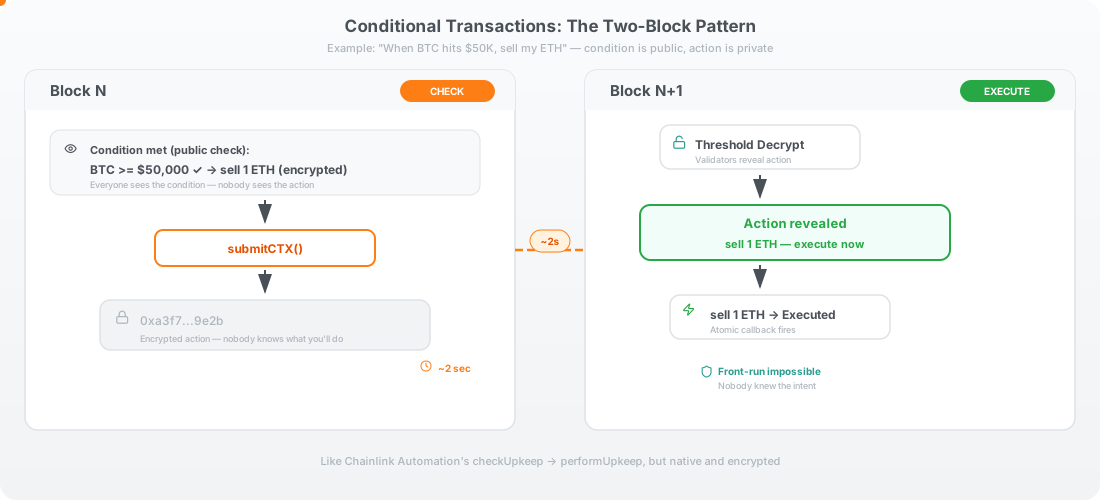
- User or agent submits encrypted data to a contract. It stays encrypted in storage.
- When conditions are met, the contract calls
submitCTX() - Validators batch all decryption requests from block N
- Block N+1 executes all
onDecrypt()callbacks with decrypted data
This is a two-block operation. The callback executes with an ephemeral sender address — not the original submitter.
Comparison: Chainlink Automation
If you've worked with Chainlink Automation, the mental model is similar. Both enable condition-triggered smart contract execution. The key difference: CTX adds encryption.
| Aspect | Chainlink Automation | SKALE CTX |
|---|---|---|
| Pattern | checkUpkeep() → performUpkeep() | submitCTX() → onDecrypt() |
| Condition Check | Off-chain DON simulation (OCR3) | Onchain threshold decryption |
| Privacy | No — upkeep data is public | Yes — data encrypted until decryption |
| Dependency | External oracle network | Native chain infrastructure |
| Latency | Variable (depends on DON consensus) | N+1 blocks (target) |
| Failure Mode | performUpkeep can fail/revert | Atomic execution (subject to block gas) |
| Cost | Requires LINK token payments | Free (zero gas on SKALE) |
Breaking EVM Assumptions
EVM developers assume atomicity. You call a function, state changes, the transaction succeeds or reverts — all in one block. CTXs break this assumption intentionally.
When submitCTX() executes, the decryption does not happen immediately. It queues for the next block's batch decryption. This means:
- You cannot read decrypted results in the same transaction
- Logic must be structured as callbacks, not synchronous reads
- Multiple decryption requests from the same block batch together
The batching is the feature. All requests from block N decrypt simultaneously in block N+1, processed in order of creation. If block gas is exhausted, remaining decryptions roll over to the next block. This eliminates timing advantages — a sealed-bid auction where all bids decrypt together is fundamentally fairer than sequential reveals.
The Supplicant Interface
Contracts that receive CTX callbacks implement a standard interface:
interface IBiteSupplicant {
function onDecrypt(
bytes[] calldata decryptedArguments,
bytes[] calldata plaintextArguments
) external;
}When the committee decrypts, every registered supplicant's onDecrypt() fires. This enables complex multi-party workflows where multiple contracts react to the same decryption event.
Use Cases for AI Agents
Encrypted Strategy Parameters. A trading agent stores rebalancing thresholds, price triggers, and position limits encrypted onchain. The contract only decrypts and executes when market conditions match. Competitors see that something triggered — not what the thresholds were.
Sealed Agent-to-Agent Negotiations. Two agents submit encrypted terms for a task. The contract decrypts both simultaneously when both sides have submitted, executing on the overlap. Neither agent sees the other's terms until reveal — eliminating first-mover disadvantage.
Conditional Autonomous Payments. Payment triggers fire only after decryption confirms a condition — delivery of data, completion of compute, verification of a result. This is "if/then" financial logic enforced by the chain.
Time-Locked Reveals. Encrypted data that automatically decrypts at a specific block number. Research swarms publish findings simultaneously. Prediction markets seal predictions until events resolve.
CTXs and Encrypted Transactions
| Encrypted Transactions | CTXs | |
|---|---|---|
| What's encrypted | Transaction data (calldata, destination) | Smart contract storage (state, parameters) |
| When it's decrypted | After block finalization | When contract triggers CTX |
| Protection model | Transit encryption | Conditional execution on encrypted state |
| Developer interface | Transparent (automatic) | Callback pattern (onDecrypt()) |
| Execution model | Same-block | Two-block (request in N, execute in N+1) |
Together they form complete privacy: encrypted in transit, encrypted state executed only when conditions are met.
Want to Build with CTXs?
If you're building something that needs conditional execution on encrypted state, reach out.