
Encrypting Intent: The Agent Infrastructure Gap
MEV bots consume over 50% of gas on leading L2s while paying less than 10% of fees. [1] But the infrastructure cost is only half the story — the real damage is to users. Every transaction you submit broadcasts your intent in plaintext to the mempool: amounts, destinations, and strategies visible to every searcher, every validator, every MEV bot. Encrypted transactions change this entirely.
SKALE embeds threshold encryption into consensus. Validators see ciphertext, not calldata. Amounts, destinations, and intents remain encrypted until a supermajority collaborates to decrypt. This is not a Layer 2 add-on or an external oracle — it's protocol-level privacy with zero Solidity changes required. No TEEs, no external infrastructure.
The MEV Problem
MEV (Maximal Extractable Value) is profit extracted from transaction ordering. The mempool is a dark forest — every pending transaction is visible and exploitable. But the risk isn't just abstract market inefficiency. It's your wallet.
How Users Get Hurt
| Attack Type | What Happens to You | Source |
|---|---|---|
| Sandwich attacks | You swap 1 ETH for USDC. A bot front-runs your trade, buys the same token, and back-runs — you get a worse price. The bot pockets the spread. [1] | Flashbots, Jun 2025 |
| Front-running | Your limit order is visible before execution. Bots place identical orders ahead of yours, filling at better prices and leaving you with slippage. [2] | Oblivious Labs + Flashbots |
| Back-running | After your large trade moves the market, bots immediately trade against the price impact — extracting value you created. [2] | Oblivious Labs + Flashbots |
| Intent exposure | Your trading strategy, position size, and timing are public before execution. Competitors and arbitrageurs react in real time. | — |
| Censorship risk | Transactions can be filtered based on destination or calldata content before inclusion. Validators see everything. | — |
The mechanics are straightforward. A bot sees your swap transaction in the mempool. It front-runs with the same trade, driving up the price. Your transaction executes at the worse rate. The bot back-runs to capture the spread. This is a sandwich attack — profitable, legal, and entirely extractive. You pay the cost every time.
The Problem Is Getting Worse
Private mempools were supposed to solve this. Instead, they created a new arms race. Flashbots' 2025 research shows that MEV bots now consume over 50% of gas on top rollups [1] — they probe the chain with hundreds of failed transactions for every successful extraction, pushing fees up for everyone. A single arbitrage on Base requires ~350 failed transactions (~132M gas). The same outcome that costs 200K gas on Ethereum costs 130M gas on Base — a 650x efficiency gap. The infrastructure cost of MEV is passed directly to users through higher fees and worse execution.
Flashbots' "MEV and the Limits of Scaling" [1] concluded that MEV has become "the dominant limit to scaling blockchains" — and the primary victim is the end user.
What Encrypted Transactions Solve
Encrypted transactions make the mempool opaque. Validators reach consensus on encrypted payloads. No one sees amounts, destinations, or function calls until after finalization.
Threshold encryption uses:
- AES encryption for transaction data
- BLS threshold encryption for committee-based decryption
- Supermajority consensus — >2/3 of validators required
- Automatic decryption post-finalization
The result: full mempool privacy during consensus. No front-running. No sandwich attacks. No back-running.
How It Works
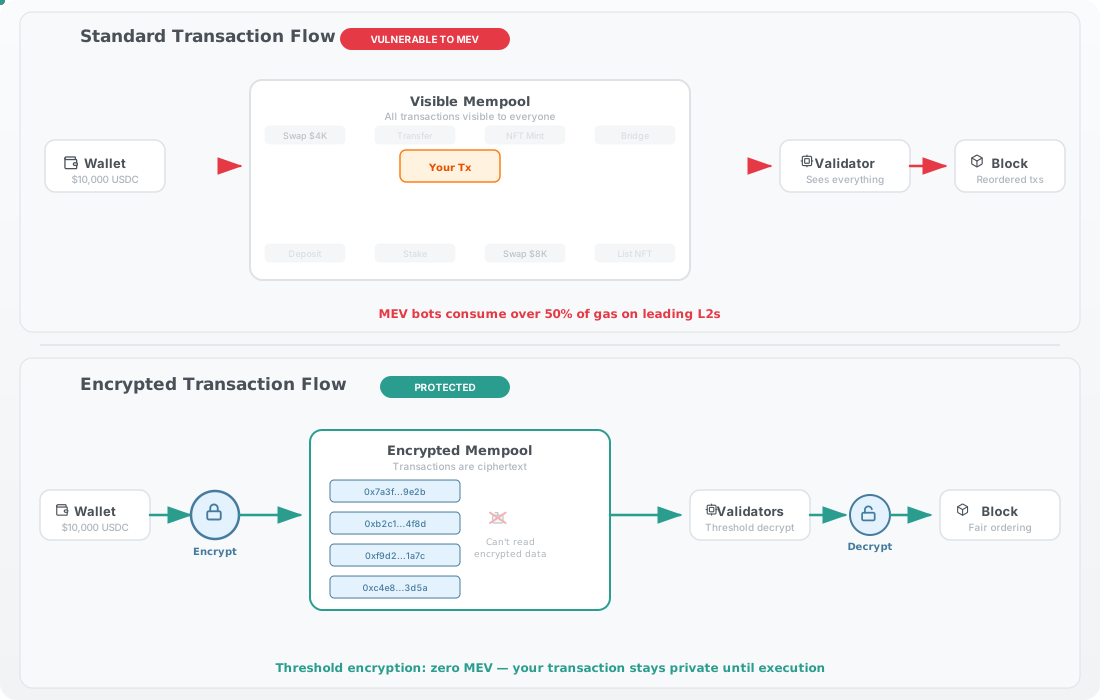
The top shows the vulnerability: transactions broadcast in plaintext to the mempool, visible to MEV bots that can sandwich attack. The bottom shows encrypted transactions: amounts and destinations remain hidden until finalization.
The committee public key encrypts. The committee private key — split across validators via threshold cryptography — decrypts. No single validator can decrypt alone. No external infrastructure required.
From a developer perspective, the change is minimal:
import { bite } from '@skalenetwork/bite'
const encryptedTx = await bite.encryptTransaction({
to: contractAddress,
data: calldata,
value: amount
})
await wallet.sendTransaction(encryptedTx)That's it. No contract rewrites. No circuit languages. No proving systems.
Use Cases
Private DeFi. Traders execute without broadcasting their positions. Strategies remain hidden until execution. No MEV extraction possible.
Confidential Intents. Users express desired outcomes — "swap ETH for USDC at market rate" — without revealing amounts or slippage tolerances. Solvers compete without seeing each other's bids.
MEV-Resistant Settlement. DCA (Dollar-Cost Averaging), TWAP (Time-Weighted Average Price), and other automated strategies execute without broadcasting timing or quantities.
Censorship Resistance. Encrypted transactions cannot be selectively filtered based on content. Validators see only ciphertext until consensus is reached.
Sources
-
Flashbots, "MEV and the Limits of Scaling," June 16, 2025. https://writings.flashbots.net/mev-and-the-limits-of-scaling
-
Oblivious Labs + Flashbots, "Scalable Oblivious Accesses to Blockchain Data," June 2, 2025. https://writings.flashbots.net/scalable-oblivious-accesses-to-blockchain-data
-
Flashbots, "Decentralized Building: Wat Do?," February 14, 2026. https://writings.flashbots.net/decentralized-building-wat-do