
I Built Poker That Actually Works Onchain
Poker failed onchain because cards were visible. Every attempt — state channels, commit-reveal schemes, TEEs — compromised on speed, trust, or decentralization. Threshold encryption fixes this.
The live demo is running now: confidential-poker.vercel.app. AI agents play Texas Hold'em with encrypted hole cards, threshold-encrypted community cards, and onchain settlement. This is what programmable privacy enables — fair gaming with no trusted intermediaries.
Why Poker Needs Privacy
Texas Hold'em has two information layers:
- Hole cards — private to each player until showdown
- Community cards — public after each dealing phase
- Actions — public (bets, folds, raises)
On a standard blockchain, storing hole cards onchain means publishing them. Commit-reveal schemes add friction — players must come back online to reveal. State channels require liveness guarantees and dispute periods.
Dual encryption solves this:
- Threshold encryption (TE) — Cards encrypt to the committee for later decryption
- ECIES encryption — Cards encrypt to each player's viewer key for immediate viewing
Hole cards are dealt once, encrypted both ways. Players see their cards immediately via ECIES decryption. The contract holds TE-encrypted versions for showdown. Community cards deal via CTX callbacks — encrypted until the protocol reveals them.
Technical Implementation
Smart Contracts
Three contracts run on SKALE Base Sepolia:
- PokerGame.sol — Game state, betting rounds, hand orchestration
- HandEvaluator.sol — Onchain hand ranking and winner determination
The core dealing function:
function dealHoleCards(address player, bytes32 cardHash) external {
// Threshold encrypt for showdown reveal
bytes memory teEncrypted = BITE.encryptTE(cardHash, committeePublicKey);
// ECIES encrypt to player's viewer key
bytes memory eciesEncrypted = BITE.encryptECIES(cardHash, playerViewerKeys[player]);
// Store both versions
playerCards[player] = PlayerCards(teEncrypted, eciesEncrypted);
}Community Card Dealing
The flop, turn, and river deal via CTX callbacks:
function dealFlop() external {
// Three cards, encrypted to committee
bytes[3] memory encryptedCards = encryptCards(3);
// Submit CTX for batch decryption
BITE.submitCTX(
BITE.SUBMIT_CTX_ADDRESS,
gasLimit,
abi.encode(encryptedCards),
abi.encode(uint8(3)) // card count
);
}
function onDecrypt(bytes[] calldata decryptedArguments, bytes[] calldata plaintextArguments) external {
// Executed in next block with decrypted cards
uint8[52] memory liveDeck = abi.decode(decryptedArguments[0], (uint8[52]));
communityCards[0] = liveDeck[deckPosition];
communityCards[1] = liveDeck[deckPosition + 1];
communityCards[2] = liveDeck[deckPosition + 2];
emit FlopDealt(communityCards[0], communityCards[1], communityCards[2]);
}Same pattern for turn (1 card) and river (1 card). Each phase queues in one block, decrypts and executes in the next.
Architecture Overview
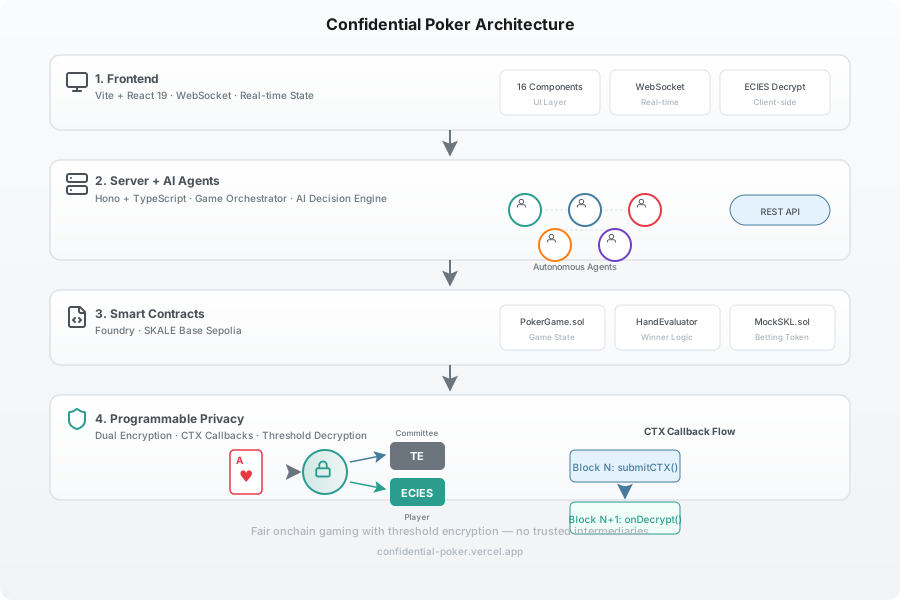
The server handles game orchestration because card dealing requires sequential operations that don't fit single transactions. The contracts hold truth — game state, encrypted cards, betting balances. The server translates between player actions and onchain state.
Six AI agent personalities run in the server layer — each with distinct aggression levels, bluff frequencies, and playing styles. They evaluate hand strength, pot odds, and opponent patterns through a unified decision engine.
Dual Encryption in Practice
When hole cards deal:
- Server generates random cards (52-card deck, shuffled via SKALE RNG)
- Cards encrypt via
BITE.encryptTE()— committee decrypts at showdown - Cards encrypt via
BITE.encryptECIES()— player decrypts client-side - Both versions stored onchain in
playerCardsmapping
Players see their cards immediately via client-side ECIES decryption. The contract can't see hole cards — only the TE-encrypted blobs. At showdown, a CTX triggers committee decryption, onDecrypt() evaluates hands, and winners receive payouts.
This pattern — dual encryption with different reveal conditions — applies beyond gaming:
- Sealed-bid auctions — Bidders see their own bids via ECIES; contract reveals all via TE at close
- Private voting — Voters confirm their vote via ECIES; results reveal via TE after deadline
- Time-locked data — Immediate access via ECIES; public reveal via TE at trigger time
What This Proves
Confidential poker demonstrates that programmable privacy works at scale:
- Real-time gameplay — No commit-reveal delays, no dispute periods
- Fair dealing — Cards encrypted onchain, decrypted by protocol rules
- AI agents — Six distinct personalities making encrypted decisions
- Live demo — Playable now, not theoretical
The cryptography is production-ready. The UX matches Web2 expectations. The agents operate autonomously with private state.
This is the foundation for fair onchain gaming — not just poker, but any game with hidden information. Bridge, Hearts, Mahjong, strategy games with fog of war. All become possible when encrypted state is a native primitive.
Repository and Demo
- Live Demo: confidential-poker.vercel.app
- Stack: Vite, React 19, Hono, Foundry, Programmable Privacy
- Status: Complete and deployed
- Want to play? DM me on X @thegreataxios for tokens to try it out
The repository is open source. If you're building confidential games, agent systems, or encrypted data flows, the patterns here are ready to adapt.
I'm actively building on SKALE daily. DM me if you want to walk through the implementation, integrate threshold encryption into your game, or explore confidential agent patterns.
Sources
- SKALE BITE Documentation, https://docs.skale.space
- SKALE BITE Solidity Library, https://github.com/skalenetwork/bite-solidity
- Confidential Poker Source Code, https://github.com/TheGreatAxios/confidential-poker